


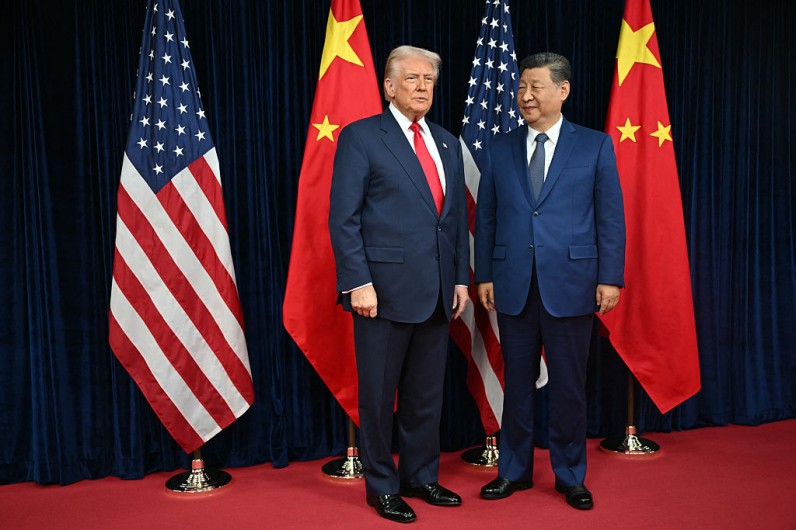
A group of top U.S. billionaires and CEOs with a combined net worth approaching $1 trillion is joining President Donald Trump for a high‑stakes meeting with Chinese President Xi Jinping in Beijing this week.
Trump arrived in China with senior executives from leading technology, finance, aerospace, and manufacturing firms. The trip underscores the economic weight of the first China summit of his second term.
The visit comes amid negotiations over tariffs, artificial intelligence rules, and U.S. arms sales to Taiwan. It also unfolds against broader security tensions involving Iran, according to CBS News.
Effect of Years of Trade and Technology Disputes
U.S. officials say the inclusion of top business leaders is meant to put corporate priorities at the center of efforts to stabilize relations. They point to years of trade and technology disputes that have unsettled companies in both countries.
Among the most prominent figures traveling with Trump are Tesla and SpaceX CEO Elon Musk, Apple CEO Tim Cook, and Nvidia CEO Jensen Huang, each with large commercial stakes in the Chinese market.
Reports indicate that, together with BlackRock CEO Larry Fink and Blackstone CEO Stephen Schwarzman, these billionaires hold fortunes in the hundreds of billions of dollars.
Their combined wealth helps bring the broader delegation's total close to the $1 trillion mark when other ultra‑wealthy executives are counted. Their participation is expected to give them direct access to Chinese leaders as they seek clarity on future rules for advanced chips, electric vehicles, and cross‑border investment, The Wire reported.
The wider group named in U.S. coverage includes Qualcomm CEO Cristiano Amon, GE Aerospace CEO Larry Culp, Citigroup CEO Jane Fraser, Micron Technology CEO Sanjay Mehrotra, Boeing CEO Kelly Ortberg, Cargill CEO Brian Sikes, and Goldman Sachs CEO David Solomon. Many of their companies depend on Chinese manufacturing or sales.
Several of the firms also face regulatory pressure in both countries over security and technology concerns. Executives are watching for signals on how strictly future rules will be enforced.
According to U.S. news reports, the Xi–Trump meetings are expected to address semiconductor supply chains, guardrails on artificial intelligence, and the possibility of adjusting some tariffs imposed in recent years.
American officials also plan to raise concerns about Chinese support for Iran and about the risk that U.S. technology could be diverted to military use.
Chinese negotiators are pushing for more predictable investment conditions. They are also opposing tighter U.S. restrictions on advanced chips from firms such as Nvidia and Micron, as per the Helsinki Times.


Join the Conversation