


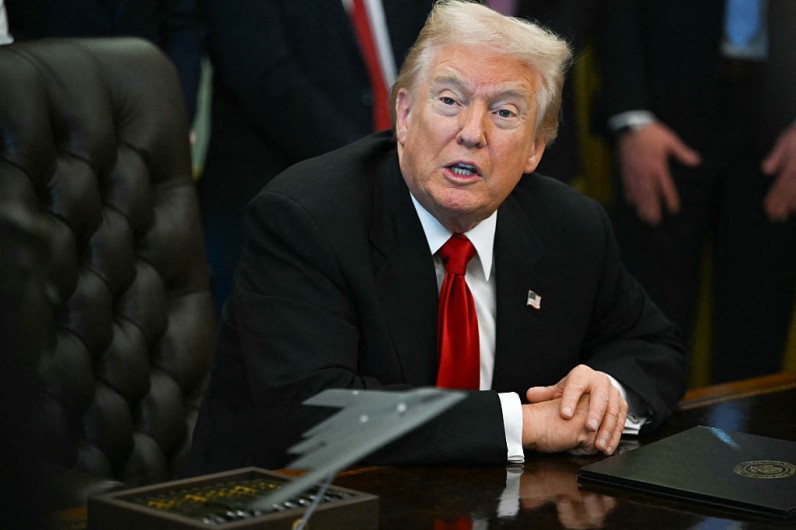
The Trump administration announced Thursday it has secured a new trade agreement with Taiwan that sets a 15% tariff rate on most Taiwanese exports to the United States, while Taipei agreed to remove or reduce 99% of its tariff barriers on US goods.
The deal, confirmed by the Office of the United States Trade Representative, aims to rebalance trade and deepen economic ties as the US remains heavily dependent on Taiwan for advanced computer chips.
According to US Census Bureau data, chip exports contributed to a trade gap of nearly $127 billion in the first 11 months of 2025.
AP News reported that under the agreement, most Taiwanese goods entering the US will face a 15% tariff — the same rate applied to regional partners such as Japan and South Korea.
In return, American exporters will gain broader access to Taiwan's markets for autos, pharmaceuticals, and agricultural products.
Trade Representative Jamieson Greer said in a statement, "President Trump's leadership in the Asia-Pacific region continues to generate prosperous trade ties for the United States with important partners across Asia, while further advancing the economic and national security interests of the American people."
Taiwan's government welcomed the agreement, saying the 15% rate allows its companies to compete fairly with other Asia-Pacific economies and removes disadvantages from the absence of a formal free trade agreement.
🚨BREAKING: TRUMP CLOSES HISTORIC TAIWAN DEAL
— NIK (@ns123abc) January 12, 2026
>u.s cuts tariffs to 15%
>tsmc commits to build 5 MORE semiconductor fabs in Arizona
>doubling the number of plants to 8 total
>deal drops this month
WE ARE SO UNBELIEVABLY BACK pic.twitter.com/bB50tYbn0s
Taiwan Pledges $250B Investment in US Trade Deal
Vice Premier Li-chiun Cheng said Taiwan hopes to become a strategic US partner "so as to jointly consolidate the democratic camp's leading position in high technology."
A key part of the agreement includes major Taiwanese investment in the United States.
Taiwan pledged $250 billion in investments across industries such as semiconductor manufacturing, artificial intelligence, and energy.
It will also offer up to another $250 billion in credit guarantees to support smaller firms expanding into the US, TheGlobeAndMail reported.
The semiconductor giant TSMC is expected to play a leading role. The company has already committed $165 billion to US projects, including fabrication plants and a research center.
American tech firms like Nvidia and AMD rely on TSMC for advanced chip production.
The Commerce Department described the broader framework as "a historic trade deal that will drive a massive reshoring of America's semiconductor sector."
In exchange, Taiwan may receive preferential treatment under a Section 232 investigation into semiconductor imports.
Taiwanese President Lai Ching-te stressed that core industries would remain protected, noting that tariffs on 93 sensitive items, including rice, will stay unchanged.
He added that as long as research and advanced manufacturing stay in Taiwan, the island can "continue to develop steadily."


Join the Conversation